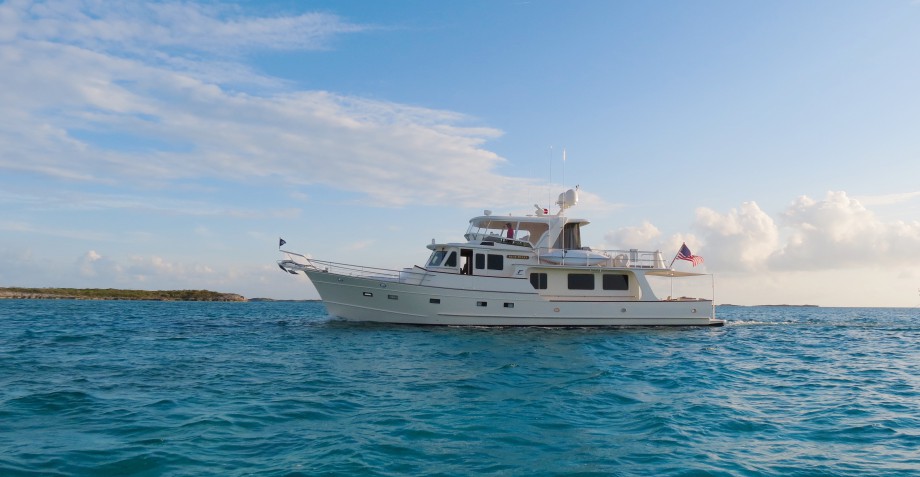
Crooked and Acklins Islands are located on the far southeastern part of the Bahamas. The people, beauty and remoteness of this area makes it among our favorite destinations. This video hopefully gives you an idea of what it is like to anchor in 40 feet of water with the stern and swim platform over the edge of a wall that drops hundreds and then thousands of feet.
A Step Back in Time – Cuba 2017!

Farmer plowing his field near Santa Maria in southwest Cuba, May 2017.
It has been difficult to know where to start explaining what Cuba is like, based on our own observations. The bottom line, however, is that the Cuban people are incredibly nice, engaging, well educated (literacy rate above 98%), vibrant and downright friendly, and the countryside and oceans are beautiful. However, we could not escape notice that Cuba is POOR, Cubans suffer a lot of deprivation (made dramatically worse after the fall of the Soviet Union), and we were stunned by the antiquated way of life. For example, though there are farm tractors, the ones we saw are old and few; the typical approach to farming is with oxen!

Old Soviet-made tractor.

Moving a disc harrow from one field to another. The oxen are owned by the government.
Outside of Havana cars and trucks are few, and they are very old. The main mode of transportation in the rural areas is by horse or bicycle, or on foot.

Cigars are a popular indulgence in Cuba. Notice the guy walking with his back to the camera carrying a cigar in his right hand.


And Cubans are incredibly resourceful. After all, there are more than 60,000 American built cars being driven in Cuba that were built prior to 1960. For the most part, these cars are maintained by their drivers. Their technical creativity extends to almost everything that needs maintenance. Here is an example:

Horse-drawn buggy equipped with a music system.
It is interesting to note that all of the horses, oxen and cows are owned by the government. Individuals can own their own pigs and chickens but if you want to buy or sell your oxen, cows or horses you have to do it through the government. In fact, penalties are very strict for killing a cow. We heard that prison terms are upwards of 20 years, and even for purchasing beef from someone who illegally killed their cow, you would end up in prison for two years.

Truckload of prisoners on their way back to prison after a days labor in the Pinar del Rio province. We were told the most likely crimes are killing an animal and drunk driving.
Being given permission to step on land in Cuba is not to be assumed. Foreigners are only permitted to step ashore after requesting and then receiving permission from the Guarda Frontera (the military homeland security). And once checked in you are not permitted to leave without checking out. In other words, they kept track of you. The process was typically friendly though always authoritative – it is important to follow their rules.

The Guarda coming on board at Maria la Gorda. Since they did not have their own boat, we had to go ashore to give him a ride.

Checking in with the Guarda. They would come aboard to fill out their paperwork and to inspect our paperwork and our boat. The inspection was only about what you had on board and not whether or not the boat was sea-worthy

A visiting American boat was as much a novelty to him as Cuba was to us. This officer asked me to take this selfie with his phone.
Despite the widespread poverty, people are cheerful! Though they all want more, many Cubans would joke about what they do not have and how hard it is to find the item to buy even if they have the money to spend; but most said they are thankful for their free education, free medical care and safety. And we found the Cuban people have a strong sense of fairness and are generous. It was the rare Cuban who was looking for a free handout. Whenever we offered someone something they would almost always give us something back.

We stopped along the roadside to meet this farmer and his wife. We gave the Señora a small gift, and her husband quickly reached to pick some ripe fruit for us as a gift in return.

Of the two months that we spent in Cuba, we were on land for 20 days and anchored out in the remote islands for 40 days. And we found the same thing on the ocean – people were friendly but their possessions were few and antiquated and seriously in need of repairs.

A typical Cuban fishing boat. These guys came over to trade us some fish for whatever we had – rum is a good currency!

We often wondered how they stayed afloat, especially in rough seas. Although we never saw a Cuban boat in trouble, we saw lots of sunken boats — maybe not surprising in a place that’s been inhabited by mariners for more than 500 years.

One fishing boat is towing two others and a dinghy. A fuel-saving measure?
The fishing was great in Cuba but the fishermen made it so easy to get fish that we never ran out. We were frequently approached by fishermen who wanted to trade us fish for …anything. And, as we said, Cubans do not have much so they were happy to receive almost anything we offered. Popular items were always toiletries, fishing gear, toys for their kids, and rum. They spend weeks out at a time and an ice-cold beer or coke is a welcome gift.

There are lobster EVERYWHERE in Cuba.

These guys are rangers at Cayo Campos, a tiny island and national park off the southern coast of Cuba. Although they spend 20 to 30 days at a time on the isolated islet, they do not have any motorized watercraft. They rowed out several times a week to haul their catch from traps and nets set up about 2 miles from their cabin.

location of Cayo Campos
We soon saw them struggling to row against the strong wind, so we hooked them up to our Hells Bay tender and gave them a much appreciated tow back to their camp.

Giving our row boating friends a tow back to their home.
As a token of their appreciation, and because they are very hospitable, the rangers invited us to their camp for lunch. How could we refuse!! When we asked if there was something they could use from us we got a veritable shopping list: fishhooks, a towel, coffee, toilet paper, toothbrushes and toothpaste, soap, and disposable razors. The next day we loaded up our tender with these things and headed ashore.

Popeye welcoming us ashore. The meal at Cayo Campos was special so we’ve decided to tell you about it in another post at a later date.
Not all of the boats in Cuba are old and decrepit. As we approached Cayos Cuervo (off the south-central coast near Jardines de la Reina) we spied a fleet of Cuban shrimpers anchored nearby to unload their catch onto a mothership.


Cuban shrimpers rafted to the mothership to offload their night’s catch.

Location of Cayos Cuervo
Again, the crews onboard were friendly and accommodating and definitely in need of some rum! Don and Patten handed up a bucket with a bottle in it, and they handed back the bucket with fifteen pounds of fresh shrimp.

Don and Patten head back in the Hells Bay tender after trading a single bottle of rum for fifteen pounds of shrimp.

Denise and Patten clean the shrimp fresh caught that morning.
That’s about it for now. Make sure to check out our first post about our trip: ‘Cruising Cuba, First Stop Havana.’ There is a LOT more of Cuba to show you, both above and below water so stay tuned!

Don beneath Blue Pearl with camera housing in hand.
Categories: Cuba
18 Comments
Cruising Cuba!! First Stop: Havana
Denise and Don have finally made it to Cuba. After 3 years of trying to get permission from the US Government, we were finally given permission for an extended 90 days! We decided that 60 would be enough so we set sail in the early morning of April 23rd and arrived at Marina Hemingway, just outside of Havana, around 3:00 PM the same day. Prior to our departure we were required by the US Treasury Department and our insurance company to identify and report where we were going to visit.
This map (below) shows our original plan. The areas in red are where we intend to visit land and those in green are anchorages.

April 23, 2017. Arriving in the channel that leads into Marina Hemingway (below).

The first stop in Cuba for every boat is with the Guarda Frontera (the Cuban Coast Guard). Here we are required to have our vessel and ourselves inspected by several Cuban officials. First, their Department of Health comes aboard: a nurse and a doctor, both dressed in medical whites. They took our temperatures, asked us questions about our health and about places Blue Pearl has visited. We were boarded by the Department of Agriculture. These two gentlemen questioned us about our provisions and inspected some of our fruits, vegetables and storage areas. They were friendly and also gave us an A+ for compliance. Then we were boarded by the Guarda Frontera who sat with us in our salon filling out the Cuban government’s required paperwork. They then did a cursory inspection of Blue Pearl and they too were satisfied that we were in compliance; not smuggling any weapons, satellite phones or other contraband into Cuba. The check in procedure actually went pretty quickly, considering that 17 other boats from The Ocean Reef Yacht Club arrived on the same day. Because of poor weather, we were delayed from our original departure date so it was a coincidence that so many of our friends were arriving at the same time, and it was great to be able to join them in some of their festivities.
Below: Don, with paperwork in hand, departing the Guarda Frontera office (below).

After checking in we were allowed to enter the marina.
This is our first view of Marina Hemingway (below).

The marina is made up of long channels where all docking is along concrete walls. The walls are in pretty rough shape but the power we had to Blue Pearl was very good. EVERYONE we met, whether they worked at the marina or were locals using the facilities, were very friendly and accommodating. Security is very tight and many individuals are apparently working undercover for your protection, and theirs!
Our new home in Marina Hemingway for 4 nights (below).

While in Havana we decided to tour the city. We hired two professional guides, Yannay and Victor, to show us around the city. Yannay did the talking and Victor did the driving – in a very comfortable air conditioned van. They were both very nice and very informative. One of the first things Yannay told us is that they, like everyone in Cuba, work for and are paid by the Cuban government.
Yannay and Denise strolling with protection from the sun (below).

The Prado in Havana (below). This is the first paved street in Havana and is the dividing line between central Havana and Old Havana. This area is lined with hotels, cinemas and mansions; much fancier than anywhere else we visited in Cuba.

In addition to all the must-see places in Havana, like the Prado, our guide took us to see the unexpected in Havana, like a neighborhood called Fusterlandia where an artist named Fuster started tiling his buildings, and over time all the neighbors followed suit. Many of the individual tiles are each a small work of art or poetry.
Below: Fuster’s home in Fusterlandia. He still lives there but the house is open for tourists most days.

The sight of old American cars as the primary vehicles in Havana feels for a moment like you are catapulted back to 1958, and the sense of time warp is enhanced by both the Colonial buildings, people in costume for the tourists, and the most contemporary cosmopolitan Habaneros and visitors from all over the world.
Photos Below: sights in Old Havana


Education is free in Cuba, (all the way through University if one passes the entrance exams) and the literacy rate is a remarkable 99.8%!! The families need pay only for the uniforms which are relatively inexpensive.
Below: School girls


Below: A view of Havana from the Bell Tower at the Church of San Francisco

Below: The Malecon. The seawall that protects Havana is a popular place for people to stroll and look out to sea.  Ernest Hemingway remains the most well-known of all Americans. We paid a short visit to the town of Cojima, where Hemingway kept his boat Pilar. The townspeople pooled their resources and had a bronze bust of a laughing “Papa” Hemingway commissioned for their town square. We were immediately serenaded with a song about “Florida Y Cuba.” The old man did not speak but the younger said that he had known Hemingway.

At the Spanish fort in Cojima we also made the acquaintance of two ladies who were carrying a bucket of scrap food for their pigs. They were cheerful and laughed so easily. Guadelupe let me know that she needs new shoes and our feet are about the same size… “Que lastima” that I had only the pair of shoes on my feet, but she laughed at that too.

Yannay gave us an opportunity to see a tiny bit of how ordinary people live in Havana. In the old houses, often four generations live together. Everyone is entitled to ration cards to meet their minimal needs, and every neighborhood has a Bodega where those tickets are exchanged for food, soap, etc.


Below: near the Malecon the US Embassy is now open. Directly opposite the Embassy gates are huge billboards proclaiming Cuban revolutionary slogans.

Below: a night at the Tropicana. Live orchestra and fabulous singers, countless gorgeous sinuous women dancers, and perfect athletic men — more extravagant than anything I’ve seen in Las Vegas! Our final throwback to the pre-revolution world of Havana.

We have left Havana for our cruise around Cuba. Our route is counter-clockwise to the west. Stay tuned! We will post more of what we see! However, one of our problems is internet connectivity. The internet in Cuba is VERY slow and access to it can only be purchased in one or three hour increments. It is interesting that internet time can only be purchased from government controlled kiosks and photo ID is required. At this point in time, we have been cruising for 33 days and 27 of those have been on anchor, far from an internet site. So when we get the time to organize our photos and thoughts beyond Havana and arrive at another place where we can connect to the internet we will post more.
Categories: Cuba
12 Comments
The Mighty Loggerhead!

One day last spring we decided to dive on Molasses Reef in the Florida Keys. It was a blustery day and the currents beneath the surface were strong. Nevertheless, we made our way from the stern of Blue Pearl to the anchor line and descended to about 60 feet to check out the wonders below. Don was off photographing some fish among the corals when all of the sudden an ENORMOUS loggerhead turtle came up to Denise for a visit! With Don’s back to the scene she was able to photograph this beautiful animal with her GoPro. What is particularly special about this visit was the fact that this loggerhead is an adult male (see if you can tell – LOL) and was obviously (!!) out looking for some female companionship.
Loggerheads are an endangered species, and seeing a full grown adult which may weigh between 300 to 450 lbs, is an especially rare event in the Keys.
In 2012 Scientific American published an interesting article related to what we saw here. If you would like to read more the link is here:
https://blogs.scientificamerican.com/tetrapod-zoology/terrifying-sex-organs-of-male-turtles/#.
Categories: Florida
6 Comments
Floating……….
Off the southeast coast of South Cat Cay, Bahamas. We have rarely seen the Atlantic Ocean so perfectly calm. For days the water undulated like silk without even a cat’s paw to mar the surface. The area of Cat Cay (Bimini) are the Bahamian islands closest to the coast of Florida, but this little spot was as peaceful as one could hope for.
Categories: Bahamas
10 Comments
Happy 4th of July!

The US Coast Guard Cutter Duane, photographed from a depth of 100′ off of Key Largo, FL. ©Don Bermant
One of the spectacular dive sites near our home port in Ocean Reef, Florida, is the US Coast Guard Cutter Duane. Launched in 1936 The Duane served a diverse and distinguished 49-year career from the South Pacific and Vietnam to Greenland and the Mediterranean. The Duane was decommissioned on August 1, 1985 as the oldest active U.S. military vessel. The cutter was deliberately sunk on November 27, 1987 to create an artificial reef about a mile south of Molasses Reef.
We have made one dive on The Duane and look forward to many more to explore this huge ship; in a single dive we examined only about one-half of her 327 ft. length (beam 41 ft). She rests upright in 118 ft. deep water with the main deck level at 100 ft.
Categories: Florida
2 Comments
Sharks!

Reef shark (Carcharhinus perezii). Click on photo to enlarge.
In the Bahamas we see sharks on nearly every scuba dive. Most of the time you can bet that sharks see us even when we don’t see them. Often we will see a shark in the distance, which never approaches. But in San Salvador, Conception Island and Crooked Island, the Reef Sharks tend to pass repeatedly, sometimes within about 12 feet of us, then veer away, and come back to do it again.
 We do not know if they are just patrolling their regular territory, or if they are hoping that we are a big predator who might injure some fish they can grab. In fact, that is how most shark bites occur: a diver has speared a fish and the sharks sense the wounded animal and goes for it. Reef Sharks are in the family of Requiem Sharks and are considered dangerous.

So even though we see them frequently, we remain wary and keep an eye on any sharks that approach. Easier said than done! They and we are moving in three dimensions so we have to be looking up, and looking down, as well as side-to-side! And then when you have two or three sharks to keep track of, well….it can get exciting!

When we see a shark, what we normally do is stay close to each other, low to the corals or back to the wall and watch until we discern the pattern to their cruising. Then as long as they are behaving normally we go on with our dive, still keeping one eye on them. What you should never do is frantically swim away from an approaching shark. Instead, you should face the shark head on and portray confidence to give the shark the idea that if it approaches you it will get hurt! If you feel like you want to get out of there, stick together and return to the boat calmly. With the Reef Sharks we have never felt like we needed to cut short our dive.

Reef shark at Crooked Island, Bahamas (Click on photo to enlarge)
On some of these dives Don got some nice photos with the Canon 5D Mark III, and Denise shot some great video with the GoPro Hero4. This video clip (below) includes a shark eating a little fish! Enjoy!
Categories: Bahamas
7 Comments
Sponge Bob the Nassau Grouper
Play video by hitting arrow
SAN SALVADOR: May 2015. Captain Bruce Niro has been guiding divers and fishermen on San Salvador for over 21 years and he knows those amazing wall dives the way you know your backyard flower garden. For over two years Bruce has been taming a fish, a female Nassau Grouper he calls Sponge Bob. With a lot of patience and gentleness, and frequent treats of speared Lionfish, Sponge Bob has developed a very dog-like behavior: she comes when Bruce taps his spear, she allows Bruce to touch her head and face, she passes through a hoop held up for her, and she follows Bruce for the entire dive. Other groupers on that reef are becoming tame also from Sponge Bob’s example.
Nassau Groupers live about 25 years. The Nassau Grouper was placed on the World Conservation Union’s redlist of threatened species in 1996, and it was determined to be endangered because its population has declined by 60% in the past 30 years. Over a third of spawning aggregations have been estimated to have disappeared, and the grouper is considered to be commercially extinct in some areas. The current population is estimated to be more than 10,000 mature individuals, but is thought to be decreasing. Their suitable habitat is declining; they need quality coral reef habitats to survive. Their population outlook is not optimistic. The Bahamas has a ban on fishing for Nassau Grouper during their spawning season, but the rest of the year they are often on the menu. Protected Bahamas National Land & Sea Parks are a step to help this species recover.
On this dive Bruce feeds Sponge Bob a Lionfish that Bruce had just speared. You might ask, besides feeding Sponge Bob, why spear a Lionfish? Lionfish are an invasive species from the Indo-Pacific, believed to have escaped from aquariums or hitchhiked in the bilges of international freighters. Beautiful but deadly, they have multiple venomous spines disguised by ornate frond-like waving fins, and they are voracious hunters who are decimating the population of native reef fishes. Both in the Bahamas and in the U.S. we are encouraged to kill as many Lionfish as possible. “The Lionfish Cookbook” is a good encouragement to eat them too! We hope you enjoy this little video.
Categories: Bahamas
11 Comments
Diving with a Stingray
There is a beautiful little spot in the Exumas in a channel between Pasture Cay, O’Brien’s Cay and Little Hall Pond Cay where a small plane (allegedly carrying drugs) crashed and still sits.

Denise checking out the plane. (Click on photo to enlarge)
Its a shallow dive with the plane sitting in only about 25 feet of water and the nearby reef dropping to about 40 or 50 feet. Here are some photos of the reef nearby the plane.

Common Sea Fan sitting atop of bed of coral encrusted with Sea Rods, Yellow Tube Sponge, Sea Whips and others. (Click on photo to enlarge).

Lobster peering out from beneath a mound of Pillar Coral. (Click on photo to enlarge)

Trumpet fish blending in with Row Pore Rope Sponges, Gorgonians, Sea Fans and others. (Click on photo to enlarge)
During our travels through this underwater garden we spotted a resting Sting Ray.

Sting Ray hiding beneath a coating of sand! (Click on photo to enlarge)

These creatures are not very threatening, as long as you keep clear of its long tail! It has a spine atop which it can thrust straight up and thrash about to keep you away or attack. They use this spine to fend off sharks and other predators. Steve Irwin, ‘The Crocodile Hunter’ was killed in 2006 by a Sting Ray. Denise wakes up the sleeping guy and then heads him off at the pass! These are beautiful creatures, check out this video and enjoy!!
Categories: Bahamas
5 Comments
Dancing With a Dolphin
We decided to do a wall dive off the coast of Conception Island (southeastern Bahamas). We gathered our gear and selected a spot on the west side of the island just south of Conception Creek where the sea floor at 60 feet dropped over a wall straight down to about 300 feet and then sloped off to thousands! We donned our gear and descended along our anchor line to 60 feet. Then we proceeded to the wall. At around 80 feet Denise was gazing off into the deep blue of the steep slope while Don poked around in the coral on the wall. All of a sudden, Don sensed a creature peering over his left shoulder and he turned his head to find himself face to face with a Bottlenose Dolphin – about 6 inches from his nose!!! Don immediately started clicking away with his Canon.

Photo ©Don Bermant
Then Denise turned about and saw what was going on!

She swam towards the Dolphin and the Dolphin swam towards Denise!!

Together the Dolphin and Denise swam back over to the sea floor at 60 feet and started this little dance! Check it out.


This went on for about 15 minutes during which the Dolphin went to the surface 5 times to get air before coming back down to play some more. It was an unforgettable experience. We started running low on air so had to surface as well. Here is a final shot of the Dolphin leaving us. Stay tuned to this site for the videos from Denise’s GoPro.

Categories: Bahamas
13 Comments