
Farmer plowing his field near Santa Maria in southwest Cuba, May 2017.
It has been difficult to know where to start explaining what Cuba is like, based on our own observations. The bottom line, however, is that the Cuban people are incredibly nice, engaging, well educated (literacy rate above 98%), vibrant and downright friendly, and the countryside and oceans are beautiful. However, we could not escape notice that Cuba is POOR, Cubans suffer a lot of deprivation (made dramatically worse after the fall of the Soviet Union), and we were stunned by the antiquated way of life. For example, though there are farm tractors, the ones we saw are old and few; the typical approach to farming is with oxen!

Old Soviet-made tractor.

Moving a disc harrow from one field to another. The oxen are owned by the government.
Outside of Havana cars and trucks are few, and they are very old. The main mode of transportation in the rural areas is by horse or bicycle, or on foot.

Cigars are a popular indulgence in Cuba. Notice the guy walking with his back to the camera carrying a cigar in his right hand.


And Cubans are incredibly resourceful. After all, there are more than 60,000 American built cars being driven in Cuba that were built prior to 1960. For the most part, these cars are maintained by their drivers. Their technical creativity extends to almost everything that needs maintenance. Here is an example:

Horse-drawn buggy equipped with a music system.
It is interesting to note that all of the horses, oxen and cows are owned by the government. Individuals can own their own pigs and chickens but if you want to buy or sell your oxen, cows or horses you have to do it through the government. In fact, penalties are very strict for killing a cow. We heard that prison terms are upwards of 20 years, and even for purchasing beef from someone who illegally killed their cow, you would end up in prison for two years.

Truckload of prisoners on their way back to prison after a days labor in the Pinar del Rio province. We were told the most likely crimes are killing an animal and drunk driving.
Being given permission to step on land in Cuba is not to be assumed. Foreigners are only permitted to step ashore after requesting and then receiving permission from the Guarda Frontera (the military homeland security). And once checked in you are not permitted to leave without checking out. In other words, they kept track of you. The process was typically friendly though always authoritative – it is important to follow their rules.

The Guarda coming on board at Maria la Gorda. Since they did not have their own boat, we had to go ashore to give him a ride.

Checking in with the Guarda. They would come aboard to fill out their paperwork and to inspect our paperwork and our boat. The inspection was only about what you had on board and not whether or not the boat was sea-worthy

A visiting American boat was as much a novelty to him as Cuba was to us. This officer asked me to take this selfie with his phone.
Despite the widespread poverty, people are cheerful! Though they all want more, many Cubans would joke about what they do not have and how hard it is to find the item to buy even if they have the money to spend; but most said they are thankful for their free education, free medical care and safety. And we found the Cuban people have a strong sense of fairness and are generous. It was the rare Cuban who was looking for a free handout. Whenever we offered someone something they would almost always give us something back.

We stopped along the roadside to meet this farmer and his wife. We gave the Señora a small gift, and her husband quickly reached to pick some ripe fruit for us as a gift in return.

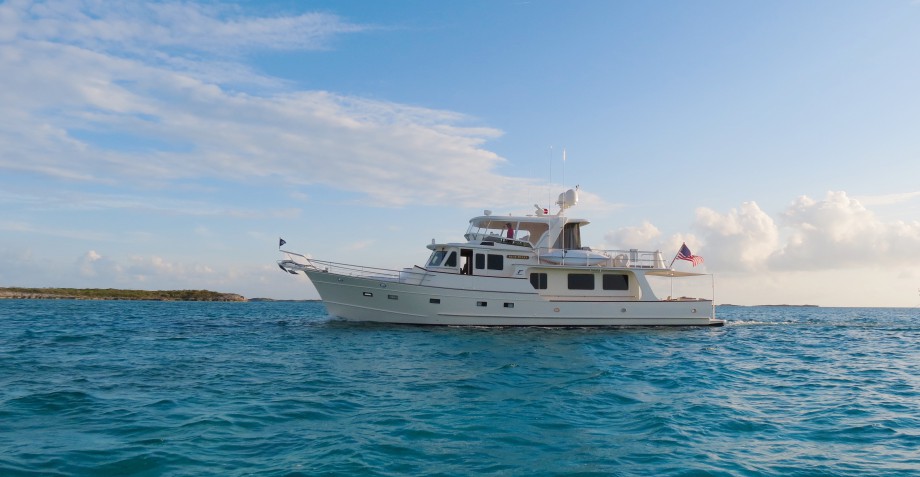
Of the two months that we spent in Cuba, we were on land for 20 days and anchored out in the remote islands for 40 days. And we found the same thing on the ocean – people were friendly but their possessions were few and antiquated and seriously in need of repairs.

A typical Cuban fishing boat. These guys came over to trade us some fish for whatever we had – rum is a good currency!

We often wondered how they stayed afloat, especially in rough seas. Although we never saw a Cuban boat in trouble, we saw lots of sunken boats — maybe not surprising in a place that’s been inhabited by mariners for more than 500 years.

One fishing boat is towing two others and a dinghy. A fuel-saving measure?
The fishing was great in Cuba but the fishermen made it so easy to get fish that we never ran out. We were frequently approached by fishermen who wanted to trade us fish for …anything. And, as we said, Cubans do not have much so they were happy to receive almost anything we offered. Popular items were always toiletries, fishing gear, toys for their kids, and rum. They spend weeks out at a time and an ice-cold beer or coke is a welcome gift.

There are lobster EVERYWHERE in Cuba.

These guys are rangers at Cayo Campos, a tiny island and national park off the southern coast of Cuba. Although they spend 20 to 30 days at a time on the isolated islet, they do not have any motorized watercraft. They rowed out several times a week to haul their catch from traps and nets set up about 2 miles from their cabin.

location of Cayo Campos
We soon saw them struggling to row against the strong wind, so we hooked them up to our Hells Bay tender and gave them a much appreciated tow back to their camp.

Giving our row boating friends a tow back to their home.
As a token of their appreciation, and because they are very hospitable, the rangers invited us to their camp for lunch. How could we refuse!! When we asked if there was something they could use from us we got a veritable shopping list: fishhooks, a towel, coffee, toilet paper, toothbrushes and toothpaste, soap, and disposable razors. The next day we loaded up our tender with these things and headed ashore.

Popeye welcoming us ashore. The meal at Cayo Campos was special so we’ve decided to tell you about it in another post at a later date.
Not all of the boats in Cuba are old and decrepit. As we approached Cayos Cuervo (off the south-central coast near Jardines de la Reina) we spied a fleet of Cuban shrimpers anchored nearby to unload their catch onto a mothership.


Cuban shrimpers rafted to the mothership to offload their night’s catch.

Location of Cayos Cuervo
Again, the crews onboard were friendly and accommodating and definitely in need of some rum! Don and Patten handed up a bucket with a bottle in it, and they handed back the bucket with fifteen pounds of fresh shrimp.

Don and Patten head back in the Hells Bay tender after trading a single bottle of rum for fifteen pounds of shrimp.

Denise and Patten clean the shrimp fresh caught that morning.
That’s about it for now. Make sure to check out our first post about our trip: ‘Cruising Cuba, First Stop Havana.’ There is a LOT more of Cuba to show you, both above and below water so stay tuned!

Don beneath Blue Pearl with camera housing in hand.